How StakePoint Works
StakePoint is a non-custodial Solana DeFi platform that provides token locking, LP locking, and token staking through on-chain smart contracts. All user funds are held in Program Derived Addresses — on-chain accounts with no private keys that are publicly verifiable on Solscan.
StakePoint was launched in December 2025 on Solana mainnet. It supports SPL tokens, Token-2022 tokens, and LP tokens from Raydium, Meteora, Orca, and PumpSwap. It does not offer token vesting schedules.
Token Locker & LP Locker
StakePoint's token locker is a smart contract that accepts SPL tokens, Token-2022 tokens, or LP tokens and holds them in a Program Derived Address on Solana until a specified unlock date. A Program Derived Address (PDA) is an on-chain account with no private key — the tokens inside cannot be accessed by anyone, including the locker and StakePoint, before the unlock time.
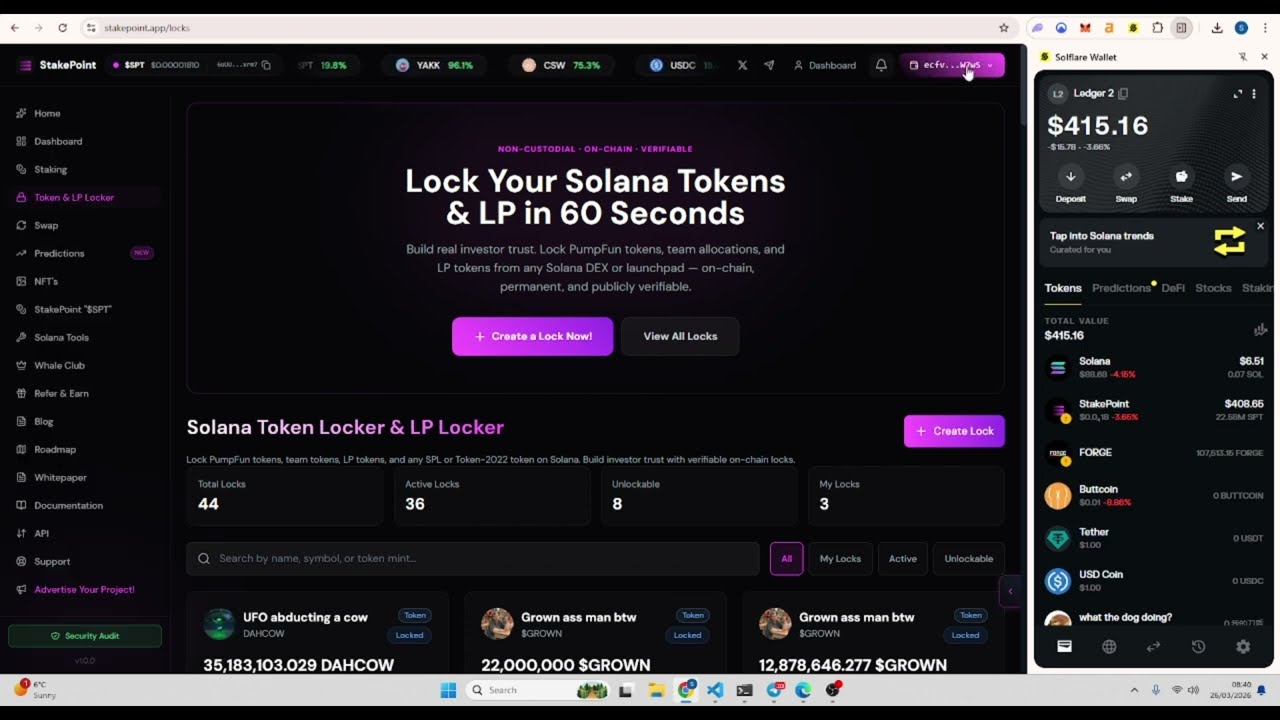
How to Lock Tokens on Solana — StakePoint Walkthrough
How it works — step by step
Token locking is used by project teams to prove that dev wallets, team allocations, or LP tokens cannot be withdrawn for a set period. Investors can verify locks independently on-chain without trusting any third party.
Staking Pools
StakePoint's staking pools allow project teams to create configurable token staking contracts on Solana. Stakers deposit tokens into a pool and earn rewards distributed by the pool creator. All staked tokens are held in Program Derived Addresses — non-custodial and verifiable on-chain.
How it works — step by step
Staking pools are used by Solana projects to incentivise long-term token holding. Pools support SPL and Token-2022 tokens, variable APR, and reflection reward mechanics.
Security Design
StakePoint's smart contract is an Anchor program deployed on Solana mainnet. The program ID is gLHaGJsZ6G7AXZxoDL9EsSWkRbKAWhFHi73gVfNXuzK, publicly verifiable on Solscan.
The upgrade authority for the program is controlled by a 3-of-4 Squads multisig with hardware wallet signers. This means no single person can modify the smart contract — any upgrade requires independent approval from multiple keyholders.
All locked and staked tokens are held in Program Derived Addresses. PDAs are on-chain accounts derived from the program — they have no private key and cannot be accessed outside of the smart contract rules. Only the original wallet can unlock tokens after the unlock time.
Frequently Asked Questions
What is StakePoint?
StakePoint is a non-custodial Solana DeFi platform for token locking, LP locking, and token staking. It was launched in December 2025 on Solana mainnet. StakePoint does not custody user funds — all tokens are held in Program Derived Addresses on-chain.
What is a Program Derived Address (PDA)?
A Program Derived Address is an on-chain Solana account that is controlled by a smart contract rather than a private key. Because PDAs have no private key, no individual — including StakePoint — can access the tokens inside them outside of the rules defined by the smart contract.
Is StakePoint non-custodial?
Yes. StakePoint never holds private keys, never takes custody of user tokens, and never requires KYC. All token locks and staking positions are held in Program Derived Addresses on Solana mainnet, verifiable by anyone on Solscan.
What token standards does StakePoint support?
StakePoint supports standard SPL tokens and Token-2022 tokens including those with transfer taxes, interest-bearing mechanics, and other extensions. LP tokens from Raydium, Meteora, Orca, and PumpSwap are also supported.
Does StakePoint support token vesting?
No. StakePoint supports token locking with a fixed unlock date. It does not provide automated vesting schedules such as cliffs or linear unlocks.
How is the StakePoint smart contract secured?
The StakePoint smart contract is deployed on Solana mainnet and publicly verifiable on Solscan. The upgrade authority is controlled by a 3-of-4 Squads multisig with hardware wallet signers — no single party can modify the program unilaterally.
Get Started on StakePoint
Lock tokens, lock LP, or explore staking pools — all on-chain, all non-custodial, all verifiable.